
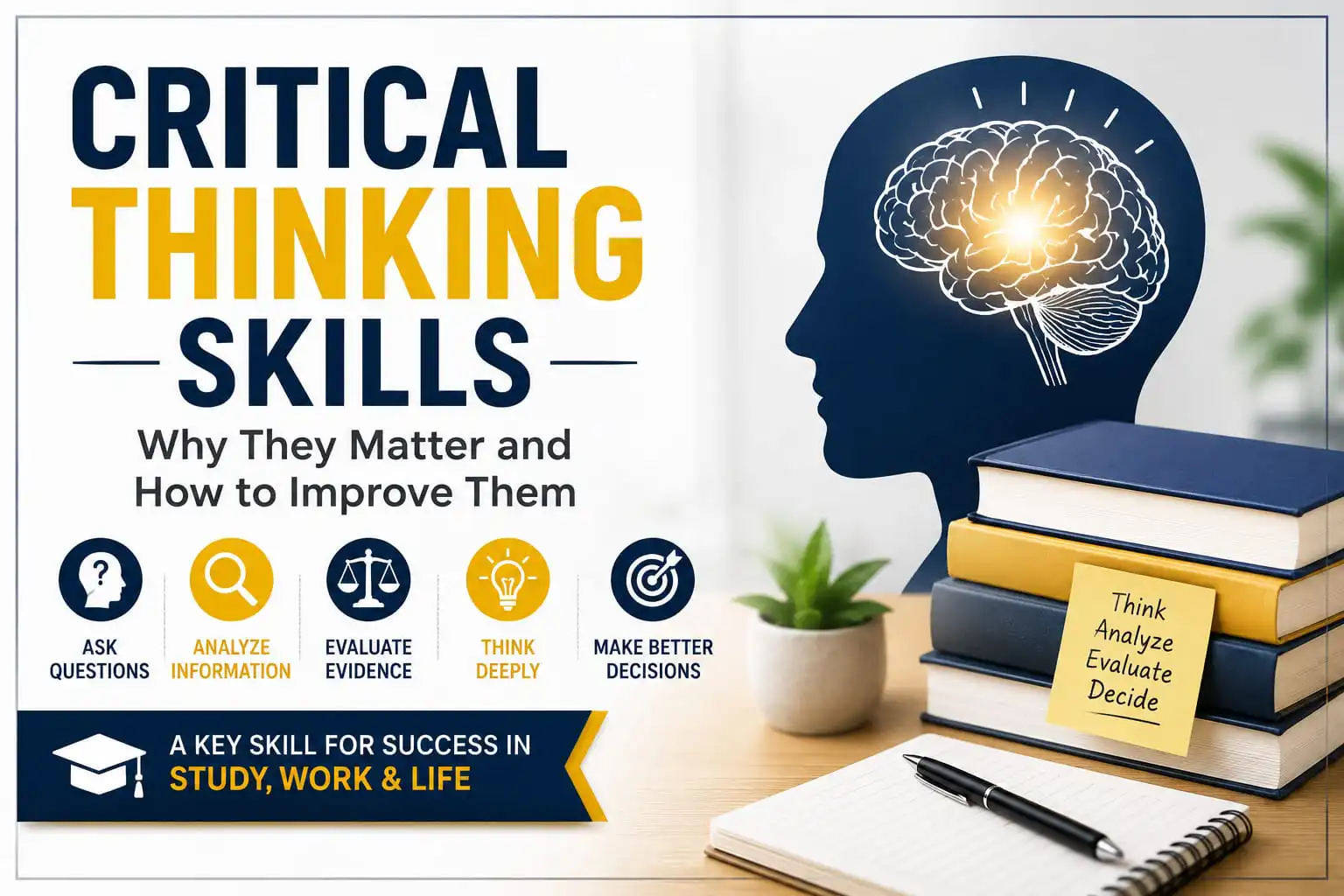
Every day, we make countless decisions. From choosing what to buy and which news to trust to solving problems at work or school, our ability to think carefully plays an important role in the quality of our decisions. This ability is known as critical thinking.
Critical thinking is not just possessing knowledge. It’s understanding that if you hear something, you are not supposed to immediately adopt it. The art is in making judgments rather than forming the habit of simply acting based upon them. You have to ask assumptions to do that; and you have to see how things are by no means what they seem the first time.
Critical thinking, these days, has become a life skill more important than ever; in our era of digital, instantaneously available-information access that helps us to steer clear of wrong information and take informed decisions for the optimum solution with the least of effort
The bright side is, a high-degree or level of critical thinking may be practiced or learned by us, individuals. It is such like one thing such as public speaking as well as a few other stuff which improve even further by regular utilization as well as awarenesses for betterment associated with skills and practices.
Here, this guide will tell you all about it – you’ll find out what critical thinking is, and why it’s so significant, plus what you can do to improve your critical thinking skills every day.
What Is Critical Thinking?
What is critical thinking? Being able to evaluate information before jumping to a conclusion is at the very core of critical thinking. Rather than passively believing information, critical thinkers pose relevant questions, assess the evidence in order to reach an informed answer, and then reflect on their decisions.
This process promotes sound reasoning and facilitates decision-making of the people in the workplace and in the personal lives.
Why Critical Thinking Is Important
Using strong critical thinking abilities enables individuals to look at circumstances more deeply and be aware of facts from less valuable information and solutions more efficiently as they develop their capabilities useful to schoolwork, jobs, companies, business ventures as well as private life.
Benefits of Critical Thinking
- Supports better decision-making.
- Improves problem-solving abilities.
- Helps identify misinformation.
- Encourages logical and independent thinking.
- Builds confidence when making important choices.
- Strengthens communication and discussion skills.
Characteristics of Critical Thinkers
People with excellent critical thinking skills have similar positive habits. These character traits enable individuals to objectively analyse and assess situations without jumping to a conclusion.
- They remain curious and ask meaningful questions.
- They consider multiple viewpoints before reaching conclusions.
- They rely on facts and evidence whenever possible.
- They are willing to change their opinion when presented with reliable information.
- They think logically instead of reacting impulsively.
Avoid Jumping to Conclusions
Avoid coming to a conclusion too early-one of the most fundamental errors of thinking is making up your mind without sufficient information to back up a conclusion, thereby limiting the choices and judgments available and encouraging misunderstandings.
Putting a little bit more time into comprehending circumstances and situation, asking a few questions and glancing through all the details would surely enhance the outcome in most situations and scenario.
Common Thinking Mistakes to Avoid
However, Everyone makes a cognitive error from time to time. In order for yourself to start improving how you’ll engage in critical thinking; the primary step is to first becomeaware of the thinking flaws you possess, this enables making sound judgments.
- Making assumptions without enough evidence.
- Believing information without checking reliable sources.
- Ignoring viewpoints that differ from your own.
- Allowing emotions to control important decisions.
- Rushing to conclusions before understanding the full situation.
Learn to Evaluate Information Carefully
Considering everything online-and it is quite enough-one should always take with an allowance for being told false tales too soon. Dependable facts consist in facts for they are supported by facts of reality: evidence, convincing information and detailed explanations.
Whenever you read an article, view a movie or video – pause for a moment and consider: Is the information accurate and even- handed? Is there legitimate evidence that backs up the material? Don’t be shy; these kinds of “due diligence” extra minutes and effort can help avoid future misunderstandings.
Ask Better Questions
Critical thinkers learn the skill of asking smart questions rather than immediately accepting information presented to them. Asking thoughtful questions promote a better level of understanding and can unearth useful data you may not of initially spotted.
Helpful Questions to Ask
- What evidence supports this claim?
- Is the information coming from a reliable source?
- Are there other possible explanations?
- What important details might be missing?
- Could personal opinions be influencing the conclusion?
Practice Looking at Different Perspectives
People see things so differently because of the varying experience they’ve had. One way of considering these multiple view points is to acknowledge that someone sees things from a slightly different perspective than you, so your opinions and judgments about them don’t become quite so unfair.
Being an active or attentive listener does not always signify your agreeing with them or anything that they have to communicate. As you pay attentive ear and hear them out so that you get more perspective of your own opinion in reference.
Apply Critical Thinking in Everyday Life
But this skill isn’t confined to the workplace or classroom. It can benefit you in numerous ways outside of those settings, like making comparisons or making choices and decisions.
Everyday Examples
- Comparing products before making a purchase.
- Checking multiple news sources before believing a story.
- Evaluating online reviews before choosing a service.
- Planning solutions instead of reacting emotionally during disagreements.
- Considering long-term consequences before making important decisions.
Daily Habits That Strengthen Critical Thinking
As any important new skill, to practice it more you’ll get better it as it is with practice, which can in time begin turning your decision into better, more objective and sure shot. Here a simple daily habits that can certainly make you a better critical thinker:
- Read from a variety of reliable sources.
- Take time before making important decisions.
- Stay curious and continue learning new topics.
- Discuss ideas respectfully with others.
- Reflect on your decisions and learn from experience.
Benefits of Strong Critical Thinking Skills
When used responsibly, critical thinking could assist us in making well-informed choices and building an even better capacity to fix the issues in the world while also growing in the processes of life. Critical thinkers are more likely to assess rather than respond on instinct.
- Improves decision-making in everyday life.
- Strengthens problem-solving abilities.
- Helps identify misinformation and unreliable claims.
- Encourages independent and logical thinking.
- Builds confidence when evaluating complex situations.
- Supports effective communication and respectful discussions.
- Promotes continuous learning and personal growth.
Frequently Asked Questions
Can critical thinking be learned?
Yes, it can be! With constant effort, all and everyone will improve his reasoning capacity skills in many cases. So it means you have can sharpen yours by inquiring and analyze reasoning evidence for and also against the question in the way you can.
Why is critical thinking important in everyday life?
Learning to do and be critical thinking allows us to come to better decisions, be better problem solvers, and to prevent ourselves from believing misinformation without question. Being more of a critical thinker will also make a difference to our personal, academic, and personal life.
What is the difference between critical thinking and criticism?
It does not revolve around criticising anyone. It encompasses examining and evaluating given facts/opinions fairly, and arrive to sound conclusions after logical deduction, which may be based on the accepted ones.
How can I improve my critical thinking every day?
We improve by consuming info from good resources, generating good inquiries, listening to different thoughts and opinions, discovering evidence before you can just buy into a notion, and checking as you make decisions.
Conclusion
You will find that critical thinking skills will be the most valuable ones for you to improve in our information-heavy age. You’ll find it will allow you to look at problems and ideas objectively, make sound judgments, and tackle challenging situations more assuredly.
Building critical thinking skills isn’t a fast process, but incorporating small, daily habits will make a difference in the long run. By cultivating a curious mind, questioning the “what is,” actively look for evidence and being open to various point of views, one day your will see a difference of how clearly and logically you think in all aspect of live!